By Keith Nichols, Principal Transportation Engineer
HRTPO recently released the 2025 edition of the Annual Roadway Performance Report. The report includes a variety of information on the performance of the roadway system in Hampton Roads. Highlights from this year’s edition of the report include: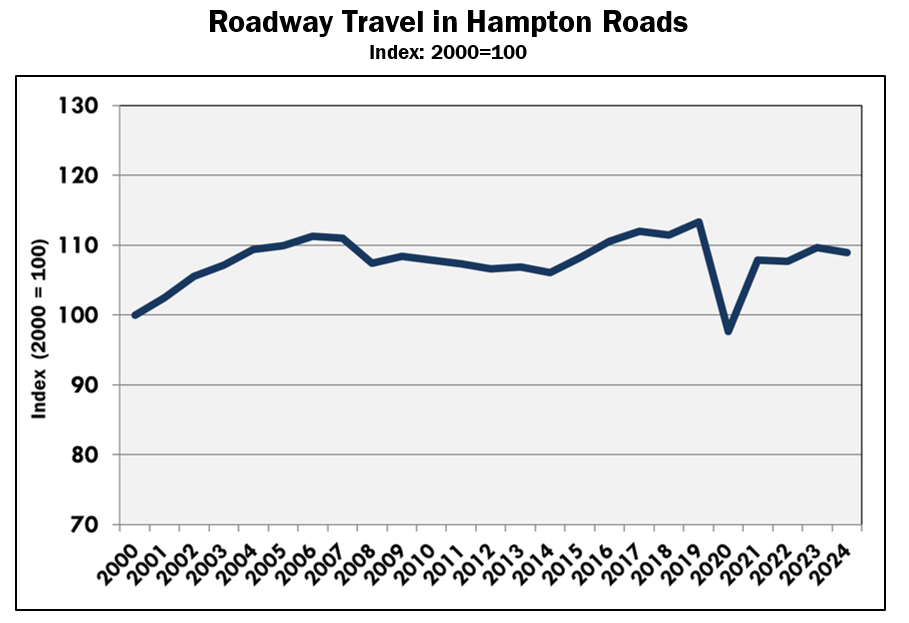
Regional roadway travel levels decreased over the last year. In Hampton Roads, there are approximately 80 locations equipped with continuous count stations, where traffic volume data is collected continuously throughout the entire year. Regional roadway travel levels decreased 0.6% from 2023 to 2024 based on the data collected at these locations, and volumes remain below the pre-pandemic levels seen in 2019.
Regional peak period congestion levels are increasing but mostly remain below pre-pandemic levels. Peak period congestion in Hampton Roads has increased since the pandemic but has not returned to pre-pandemic levels. Among major roadways, 6% of the lane-miles[i] in Hampton Roads were severely congested during the morning (AM) peak travel period in 2024, and 11% of lane-miles were severely congested during the afternoon (PM) peak travel period. Both of these values increased from 2023, but the PM peak period congestion levels remain below the levels seen in 2019.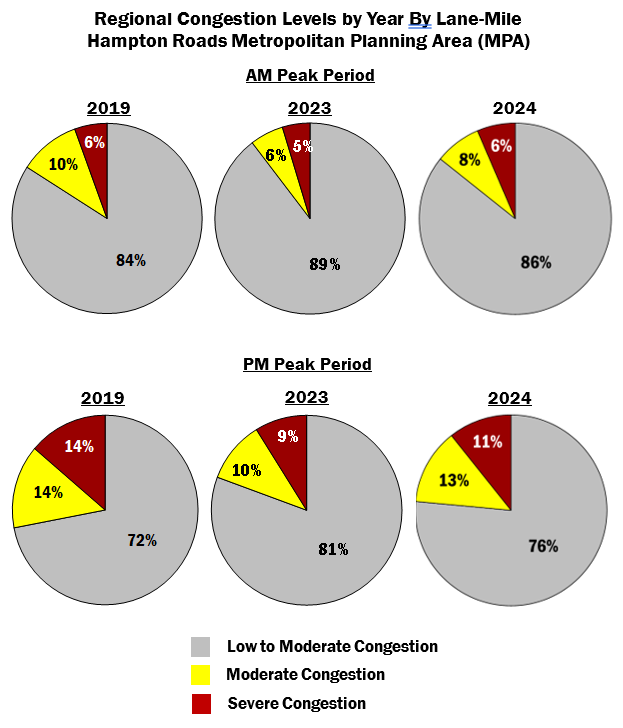
Peak Period Travel Times Continued to Increase at the Hampton Roads Bridge-Tunnel. As part of the Annual Roadway Performance Report, HRTPO staff highlighted the changes in peak period travel times over the last decade on ten major corridors in Hampton Roads. At the Hampton Roads Bridge-Tunnel (HRBT), average travel times continued to increase in 2024 as longer backups occurred due to the impacts of construction in the corridor. Average weekday travel times at the HRBT during the PM peak period are currently nearly 30 minutes in the eastbound direction and 31 minutes in the westbound direction.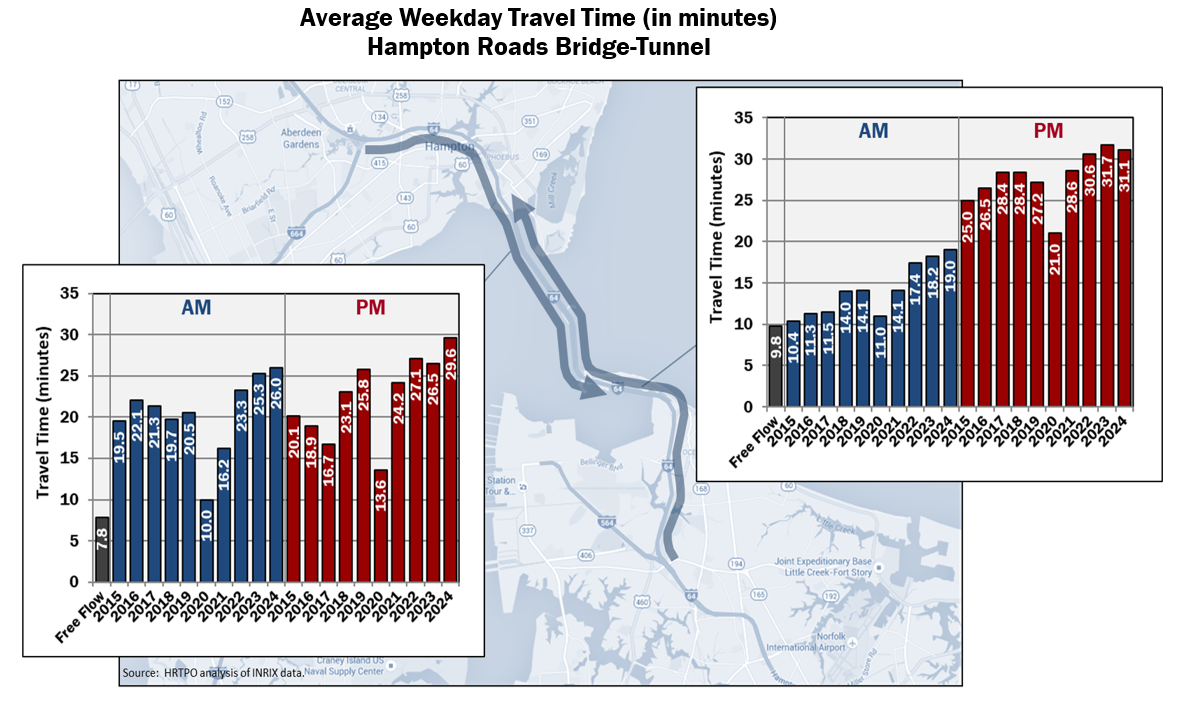
The Annual Roadway Performance Report also includes detailed information on average weekday traffic volumes, roadway travel speeds, and peak period congestion levels for each major roadway in Hampton Roads.
The Annual Roadway Performance Report is produced as part of HRTPO’s Performance Management effort and the Congestion Management Process (CMP), an on-going process that identifies, develops, evaluates, and implements transportation strategies to enhance mobility regionwide. The data included in this document is also used throughout the regional transportation planning process. Examples include the project prioritization process used for both the HRTPO Long-Range Transportation Plan (LRTP) and the Transportation Improvement Program (TIP) and various regional studies such as the Regional Freight Study.
The report is available at the following link: HRTPO Annual Roadway Performance Report – 2025 Edition. The information included in this report can also be downloaded from the Hampton Roads Geospatial Exchange Online at www.hrgeo.org.
[i] A lane-mile is defined as the length of a roadway times the number of lanes and is commonly used to describe the amount of roadway capacity. A one-mile section of a roadway that is 6 lanes wide comprises 6 lane-miles.